Why Does an Electric Oven Broil but Not Bake?
An electric oven that broils but will not bake has not necessarily lost all heating functions. Broil and Bake use different heating paths, so a working broiler confirms only one part of the system operates. For Pelham homeowners, note whether Bake stays cold, warms slowly, or stops below the selected temperature before arranging service.
Why Broil Can Work While Bake Does Not
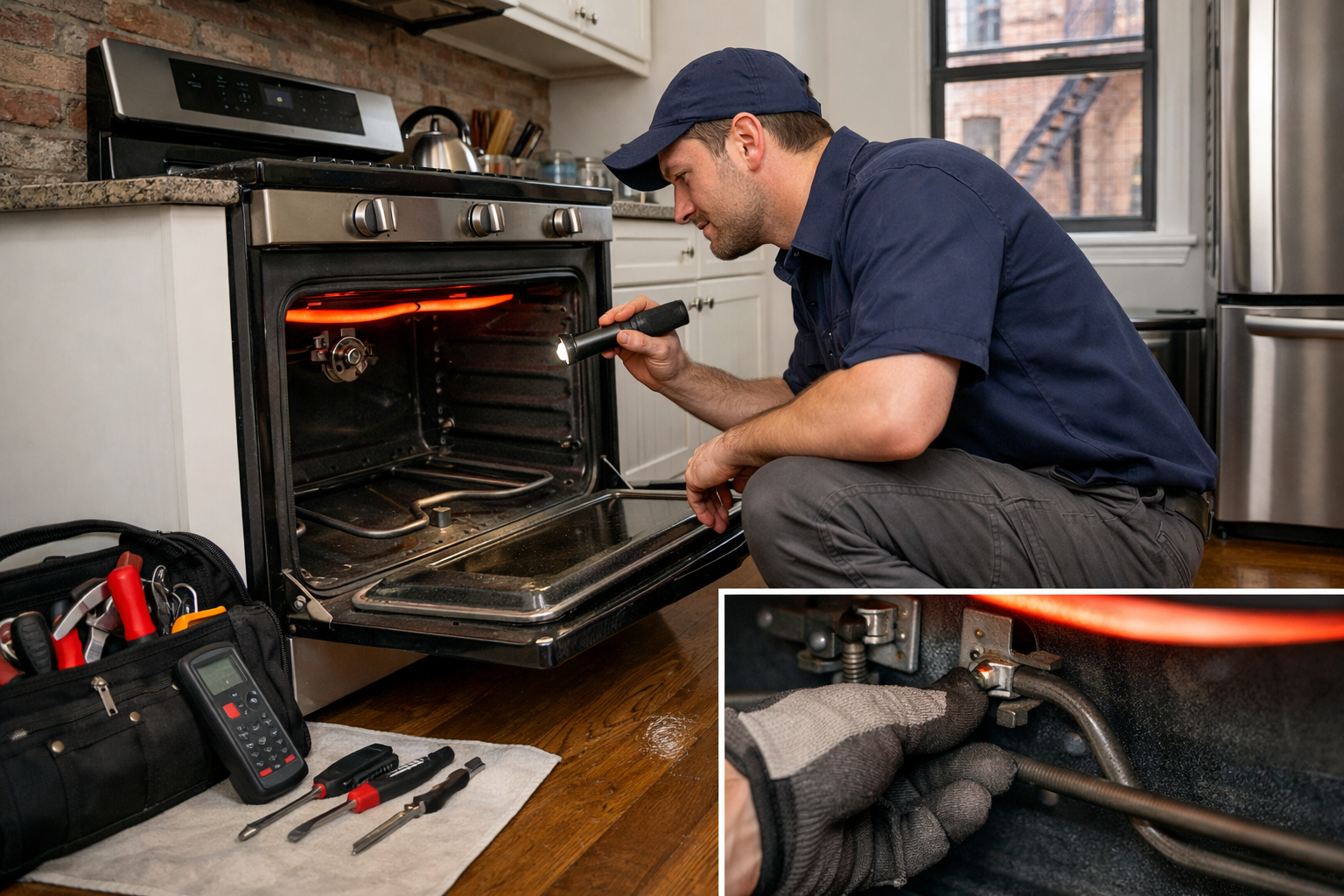
On many electric ovens, the broil element is at the top of the oven cavity, while the bake element is at the bottom or hidden beneath the oven floor. Each has its own circuit path, terminals, wiring, and control connections.
A working broiler does not prove the bake element, bake wiring, relay path, temperature-sensor input, or electronic control output is working. The oven may have power for Broil while Bake cannot deliver heat through its separate circuit.
Some ovens use the broiler during preheat, and convection modes can operate differently from standard Bake. Seeing the broiler glow during preheat therefore does not, by itself, show that the bake system is normal. Model design matters when interpreting that behavior.
Symptoms That Help Narrow Down the Problem
Record what happens after selecting Bake, including the selected temperature and approximate preheat time. A Bake setting that produces no warmth can point to a problem in the bake heating path.
An oven that warms slowly or stalls far below the selected temperature may have an element that is not delivering full heat, a connection problem, a supply issue, or a control and sensing concern. An error code can also change the diagnostic direction.
A damaged, blistered, or separated bake element is a reason to stop using the oven. However, an intact-looking element can still fail electrically, and a hidden element may offer little to inspect from inside the cavity.
Homeowners with that brand can review Whirlpool oven and range repair information when identifying their appliance and heating symptoms.
Safe Checks You Can Make Before Service
Turn the oven off and allow it to cool completely before looking inside the cavity or near the bake-element area. Record the model number, usually found around the oven door frame, drawer area, or another accessible label location.
You can safely note:
- Whether Broil heats normally
- Whether Bake stays cold, gets mildly warm, or heats very slowly
- The selected temperature and approximate preheat time
- Any displayed error message or code
- Any burning smell, sparking, smoke, or breaker activity
Check the owner manual for normal preheat behavior and accessible error-code guidance. Preheat times vary by model and selected temperature, so comparison with the manual is more useful than a general estimate.
Do not remove panels, touch wiring, pull a built-in range from cabinetry, or test energized circuits. Stop using the oven if there is smoke, sparking, a burning odor, repeated breaker trips, visible heat damage, or an obviously damaged element.
What a Technician Checks on the Bake Circuit
A proper diagnosis starts with the exact model, the mode that fails, and whether the problem repeats consistently. A technician follows the appliance’s wiring information rather than replacing a control simply because Broil works.
The inspection may include bake-element terminals, connectors, harness routing, and relay or control connections for looseness or heat damage. The bake element can be evaluated for continuity and insulation condition as appropriate.
The technician can verify commanded output and load behavior for the bake circuit, then assess the temperature-sensor and control path after the circuit basics are established. Live-voltage testing is not a homeowner task because electric ranges can involve hazardous voltage.
After repair, the oven should be checked for reliable preheat and temperature maintenance. For this type of diagnosis, see electric oven and cooktop repair in Pelham or appliance repair in White Plains.
Frequently Asked Questions
Why does my electric oven broil normally but not bake?
Broil and Bake usually use separate heating circuits. The broiler can work while the bake element, its wiring, terminals, relay path, or control output has a problem affecting the Bake function.
Can a bake element fail even if it does not look broken?
Yes. A bake element may look normal but still have an electrical failure. Hidden bake elements also cannot be fully evaluated through a visual check from inside the oven cavity.
Why does my oven get warm but not reach the set temperature?
The oven may receive some heat but not enough bake-circuit output to preheat properly. Element performance, connections, supply condition, sensor input, and control operation require model-specific diagnosis.
Does a working broiler mean the oven control board is good?
No. A working broiler confirms only that one heating function operates. It does not confirm that the control is properly commanding the separate Bake circuit or receiving the needed sensor input.
Should I use an oven with a burning smell or breaker trips?
No. Stop using the oven if there is a burning smell, smoke, sparking, visible heat damage, or repeated breaker trips. These signs require professional inspection before further operation.
You might also like